Income shows where someone stands. It doesn't show how much of that position is actually theirs.
What matters isn't just how many resources currently support someone's socioeconomic position — it's how many of those resources would still be useful if the employer, platform, institution or client behind them disappeared tomorrow. Below is a working map of that structure, useful for reading where the people you're trying to reach actually sit — not just what they earn.
Same income. Different reality.
People can earn similar money, hold similar titles, even work the same job — and still sit in very different structural positions.
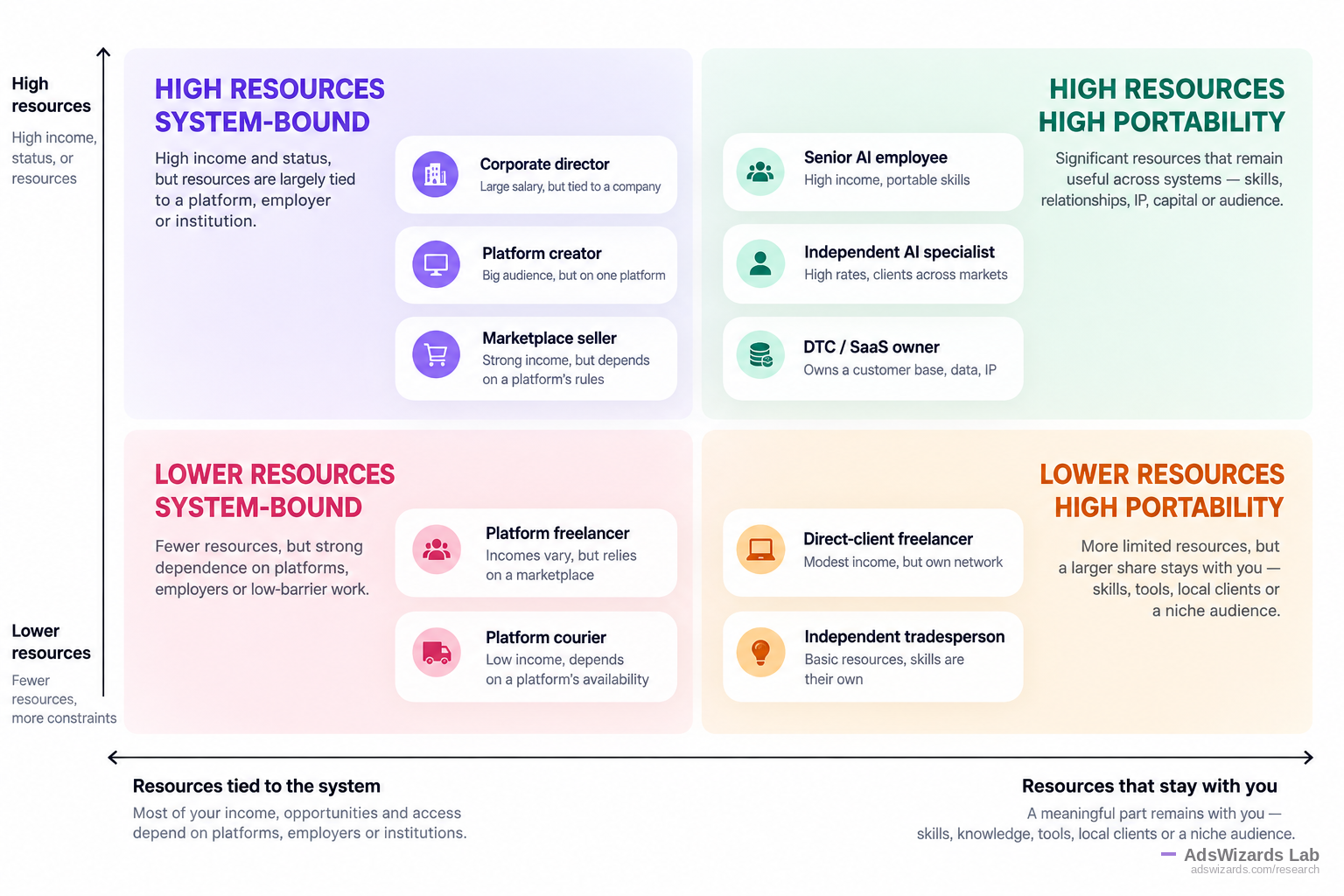
Placement is conceptual and schematic — illustrative examples, not measured positions.
Example trajectories
The point is where someone is now. Movement happens when a portable resource becomes structurally significant — not the moment someone opens a new channel.
Marketplace seller → DTC owner
Same business. More owned customer relationships.
Platform creator → Audience owner
Same audience. More direct, owned relationships.
Employee specialist → Independent
Same skill. More of its value stays with the person.
Director → External reputation
Same role. More portable professional capital.
| Position | Region | Why it sits there |
|---|---|---|
| Corporate director | High-resource / system-bound | Authority, budget and network are large but mostly organization-bound. |
| Platform creator | Mid-resource / system-bound | Reach is real but mediated almost entirely by one platform's distribution. |
| Marketplace seller | High-resource / system-bound | Revenue can be large, but ranking, reviews and customer access live inside the platform. |
| Senior AI employee | High-resource, moderately portable | One employer, but a scarce, currently in-demand skill. |
| Independent AI specialist | High-resource / high-portability | Comparable skill, sold directly — more of the value stays with the person. |
| DTC / SaaS owner | High-resource / high-portability | Customer relationships, CRM and IP survive a channel change. |
| Platform freelancer | Lower-resource / system-bound | Several clients — all originating from, and revocable by, one marketplace account. |
| Platform courier | Lower-resource / system-bound | Low resources, and access to work is entirely platform-mediated. |
| Direct-client freelancer | Lower-resource / high-portability | Same occupation as the platform freelancer — but the relationships are the person's own. |
| Independent tradesperson | Lower-resource / high-portability | Comparable income to a platform courier, but tools, licence, reputation and clients are their own. |
Same income. Same job title. Different structural position.
A profession is not a class. The map cares about what the resources behind the income actually are.
Marketplace seller
Revenue can rival a DTC business. But ranking, reviews and customer access all live inside the marketplace account — and disappear with it.
DTC / SaaS owner
Comparable revenue. But the customer list, brand and IP exist independently of any single channel.
Money alone says nothing about portability. A marketplace seller can genuinely out-earn the independent business next to them and still sit structurally to its left.
Platform-sourced freelancer
Every client relationship is intermediated — and revocable — by the same platform account.
Direct-client specialist
Same occupation, same client count. But the relationships belong to the person, not to an intermediary.
"Freelancer with five clients" describes both. It's not the label or the count that determines structural position — it's where those clients came from.
The point is where you are. The arrow is what's changing.
A position shouldn't jump every time someone opens a new channel. It should move once that channel is actually carrying structural weight.
Corporate director → director with external reputation
Same role, same employer, largely the same pay. But years of board seats, public visibility and an external network mean a meaningful share of what supports the position no longer depends on this one employer.
Platform creator → creator with owned audience
A newsletter list or direct community reaches the point where losing the platform would no longer mean losing the audience — the position moves, even if the income hasn't changed yet.
Marketplace seller starts an email list
Correct instinct, early stage. Amazon still produces nearly all of what supports this position. The point stays where it is; a short arrow marks the direction, not a destination.
Independent specialist, external demand shrinks
The skill didn't change. The market for it did. Portability is contextual — and a position can move left with the person's resource portfolio completely intact.
Digital doesn't add a new axis. It changes what's portable.
Platforms, algorithms and AI don't sit on this map as a separate "digital class." They act on the horizontal axis — changing how much of an existing resource stays useful outside the system it was built in.
- A marketplace rating is a real resource — almost entirely platform-bound.
- An owned email list or CRM relationship is a comparable resource — substantially more portable.
- Corporate authority strongly supports a position, while staying weakly portable outside the organization.
- A rare technical skill is highly portable — but only for as long as an external market wants it.
The sharpest version of this: AI can change a resource's portability without changing the resource itself, or the person, at all. A skill someone has held for years can lose external demand purely because the market around it shifted — moving their structural position left with nothing about them actually lost.
What this model claims — and what it doesn't
This is
- A conceptual framework for reasoning about structural resilience.
- A way to test whether "similar income" or "same job title" actually means "similar exposure."
- A hypothesis-generating tool — useful for asking better questions about a segment.
This is not
- A validated, population-level taxonomy.
- A scored or measured index — nothing on the map was calculated from data.
- A claim that ownership equals portability, or that entrepreneurship equals autonomy.
- A claim that any placement is permanent — portability is contextual and can shift.
Evidence and methodology
Established research this draws on
Class as multidimensional — not reducible to income (Weber, Bourdieu, Goldthorpe/EGP, Savage). Employment-relations research on authority and organization-bound status. A growing body of work on platform dependence and algorithmic management of labour, and on digital inequality more broadly.
Our structural hypothesis
That "position-supporting resources" and their "contextual portability" are a useful, non-overlapping pair of dimensions for reading structural resilience in the digital economy specifically — and that digitalization acts mainly by changing portability, not by creating a separate class system. This part is ours, not an established finding, and is offered for scrutiny rather than as a result.
What about lifestyle?
This isn't part of the structural model above — it's a separate, much weaker layer. Treat it with caution.
Observed link
Cultural participation — reading, museum and theatre attendance, consumption of "quality" media — is statistically linked to education level and cultural capital. This is a well-established result in cultural sociology (Bourdieu, DiMaggio and successors).
Possible patterns
Sport (padel, fitness), travel style, food culture, media consumption plausibly correlate with structural position, but:
- they're heavily confounded with age, cohort, geography, country, urbanity, family structure and income within the group;
- none of these patterns is measured directly for this model.
Research stays free. Support keeps it that way.
If a piece saved you time, you can back the Lab directly.